Dental implants in Tabarbour

Service overview

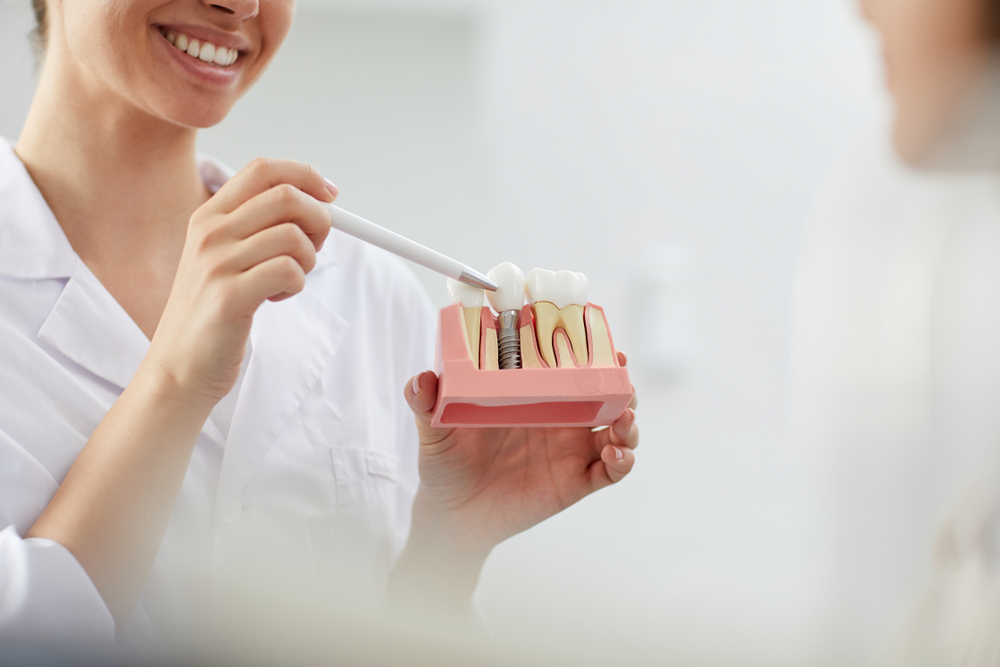
A dental implant is a titanium root placed into the jawbone to take over the job of a missing natural root, topped with a crown that looks and functions like a real tooth. It is the only option that replaces the root itself rather than just the visible part.

At Zoom Dental Clinic, every case involving dental implants in Tabarbour starts with diagnosis rather than a price quote. On-site digital panoramic imaging allows the dentist to assess jawbone density and height, nerve positions and sinus locations before any decision is made — and that assessment determines whether an implant can be placed directly or whether a preparatory step is needed first.

What makes an implant work is osseointegration: bone cells growing onto and fusing with the fixture surface over several months until it becomes a genuine part of your jaw. That fusion is what allows the implant to handle full chewing force, and it is also why implants take time and cannot be rushed, however appealing the marketing sounds.

When Is This Service Needed?

Implants come into the conversation in several situations: a single missing tooth, several adjacent missing teeth, a fully edentulous jaw, or a tooth that cannot be saved because of a fracture below the gum line or decay too extensive to restore.

They also become relevant when a removable denture shifts uncomfortably during eating or speaking, and in cases of a congenitally missing adult tooth once jaw growth is complete.

One point gets overlooked constantly: a gap at the back of the mouth deserves treatment just as much as one at the front. Molars do most of the chewing work, and losing them shifts that load onto teeth never designed to carry it — which shows up years later as wear, cracks and fractures.

An implant is not always the only option. A fixed bridge remains sensible when the neighbouring teeth need crowns anyway, and a denture still makes sense with severe bone loss or medical circumstances that rule out surgery. You are entitled to hear all three options and the reasoning behind the recommendation.

Symptoms and Warning Signs

An implant treats a loss that has already happened rather than a sudden symptom. But there are clear signs that a gap has started to cause damage and that delay is becoming expensive:

Neighbouring teeth drifting into the space, and the opposing tooth in the other jaw over-erupting in search of contact. Both change how force is distributed across your mouth and make later restoration more difficult.

Difficulty chewing on one side, so you begin favouring the other without noticing — creating uneven strain on those teeth and on the jaw joint.

Changes in the pronunciation of certain sounds when front teeth are missing, and visible gum and bone recession at the gap that shows externally as a hollow.

And finally: every month a gap goes untreated means further bone density loss at that site. That is the real reason not to postpone — not appearance.

Is the Treatment Painful?

Implant placement is performed under local anaesthesia, so no pain is felt during the procedure. What you feel is pressure and vibration, and if you experience any discomfort the dentist can add anaesthetic — you are not expected to endure it.

Most patients describe the experience as considerably less unpleasant than they expected, and many compare it to a routine extraction or something milder.

Once the anaesthetic wears off, mild discomfort or swelling for a few days is normal and is managed with prescribed pain relief and cold compresses on the first day. Comfort levels depend heavily on how carefully the case was planned: the more precise the bone and site assessment, the shorter and less invasive the surgery.

Contact the clinic if pain increases after the third day instead of easing, if swelling grows rather than subsiding, or if bleeding persists.

Appointment and Treatment Duration

Placing a single fixture usually takes between thirty and sixty minutes. The overall treatment, however, is longer, because bone needs time to integrate.

In cases that do not require bone grafting, the total timeline runs roughly three to six months. The lower jaw is typically faster because its bone is denser; the upper jaw takes longer.

Cases requiring bone grafting or a sinus lift can extend to six to nine months or beyond, since the bone-building step comes first and needs its own healing period.

Immediate placement after extraction saves an entire surgical visit, but it does not remove the integration period. It is also not suitable for everyone: it requires sufficient healthy bone around the socket and no active infection.

A note of caution: any offer promising a complete, finished implant within days without explaining the integration phase is selling a promotion, not presenting a treatment plan.

Digital Panoramic X-Ray

A panoramic image captures both jaws, all roots, the surrounding bone, nerve pathways and sinus positions in a single exposure. It is the foundation for every implant decision: is there enough bone, where exactly should the fixture sit and at what angle, and does this case need grafting first? Having the equipment in-clinic means diagnosis happens during the same visit rather than through a referral and another appointment.

Magna Dental Microscope

Magnification and focused illumination support precision in the fine work surrounding implant treatment: assessing adjacent teeth, managing soft tissue around the implant site, and refining the fit of the final restoration. Clearer vision means less intervention and a cleaner result at the gum margin — an area where any discrepancy shows immediately.

Sterilization and Infection Control Protocols

Implant placement is a surgical procedure that opens bone, and contamination at this stage is a direct cause of failed integration. All instruments are therefore handled through a dedicated sterilization room under documented infection control protocols, with single-use barriers and instruments opened in front of the patient. These are not cosmetic details — they are a direct condition of implant success.

Dr. Mutasem Irdaisat

Dentist with over 19 years of international experience.

Dr. Yola Kovalenko

Dr. Yola Kovalenka is a distinguished medical professional in the field of dentistry.

Dr. Mohammad Hatamleh

In his practice, Dr. Mohammad Hatamleh combined academic excellence with advanced clinical training.

The Experts Behind
Every Smile

At Zoom Dental Clinic, every smile is treated with care, precision, and attention to detail. Our dentists provide a wide range of dental services, from preventive care and cosmetic treatments to restorative dentistry and advanced dental solutions.

Frequently Asked Questions

How long do dental implants last?

A fixture is designed to last many years when it integrates properly and the patient maintains good oral hygiene and regular reviews. The visible crown may need replacing after a longer period through normal wear, like any restoration. Three factors influence lifespan most: smoking, neglected cleaning around the implant, and untreated night-time grinding.

Can dental implants get cavities?

The implant and crown cannot decay because they are not natural tissue. However, the surrounding gum and bone can become inflamed exactly as around a natural tooth — a condition called peri-implantitis, and the leading cause of long-term implant failure. Daily brushing, cleaning between the teeth with floss or an interdental brush, and regular professional reviews therefore remain essential even though the implant itself is artificial.

What is the difference between immediate and conventional implant placement?

With immediate placement the fixture goes in during the same visit as the extraction, saving an entire surgery and shortening the overall timeline. Conventional placement happens after the extraction site has healed. Immediate placement requires specific conditions: sufficient healthy bone around the socket and no active infection. Where those conditions exist the results are excellent; where they do not, insisting on it raises the failure risk. Your dentist decides after imaging and examination.

Does smoking prevent dental implants?

It does not rule them out absolutely, but it noticeably raises failure rates because it reduces blood flow to the gums and slows healing. Smoking is the factor most strongly linked to implant failure after infection. Abstaining before surgery and throughout the healing period is strongly advised, and stopping altogether gives the implant its best chance. Being upfront about smoking before planning helps your dentist adjust the approach — it is not something to hide.

Can diabetic patients have dental implants?

Yes, provided blood sugar is well controlled and stable, since elevated levels directly affect bone and gum healing and increase infection risk. Coordination with the treating physician is standard, along with closer post-operative monitoring. Uncontrolled diabetes is a direct reason to postpone implant surgery until it is stabilised — and that delay works in your favour, not against it.

Is there an age limit for dental implants?

There is no upper age limit as long as general health permits the procedure and the jawbone is suitable. Many successful implants are placed for patients well into later decades. The lower limit is tied to completed jaw growth, which is why implants are not placed in teenagers — temporary solutions are used until growth finishes.

Why Choose Zoom Dental Clinic ?

Why Choose Us

Modern Dental Technology

We use modern diagnostic
and treatment technology to support
accurate evaluation, detailed planning,
and precise dental care.

Experienced Dentists

Our dental team provides attentive care,
clear treatment guidance, and
recommendationsbased on each
patient’s individual needs.

Personalized Treatment

Every patient is different. We develop treatment
recommendations around your oral health,
clinical needs, comfort, and treatment goals.

Patient Comfort

From the first consultation through follow-up
care, we explain each step clearly and work
to create a calm, respectful, and
reassuring experience.

pain-free
Experience

4.9/5

Why Patients Choose Our Dental Services?

Choosing the right dental service starts with understanding your options. At Zoom Dental Clinic, we focus on clear communication, modern technology, strict sterilization, and treatment recommendations based on each patient’s individual needs.

Book Your Visit
AR