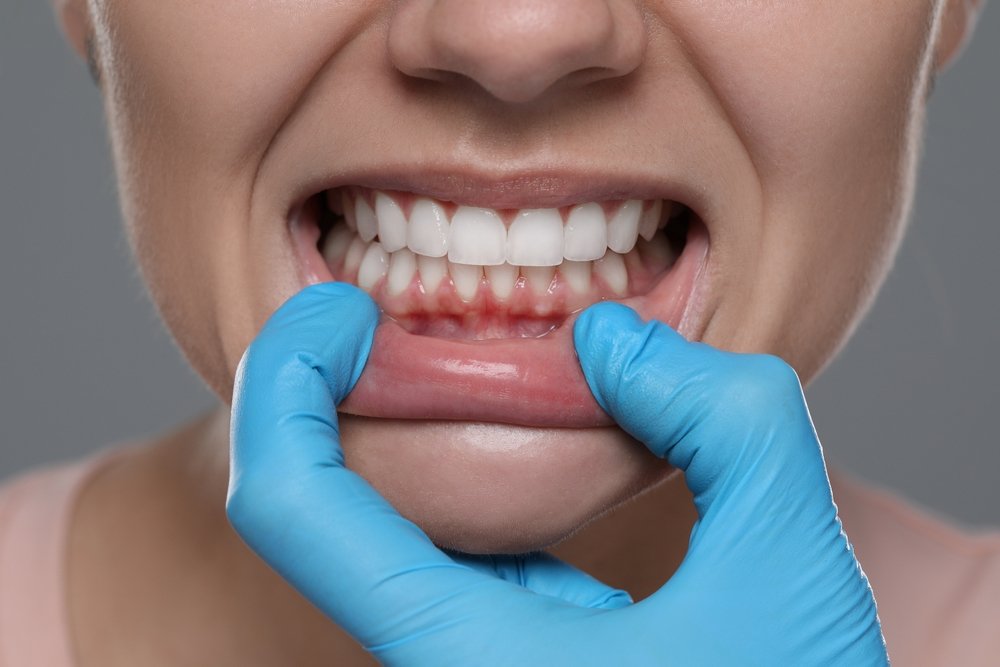
Gum treatment in Tabarbour

Service overview

Gum treatment targets the tissues that hold your teeth in place: the gums, the attaching fibres and the supporting bone. These are tissues patients rarely see, yet they determine whether the teeth stay or not.

The underlying mechanism is simple. Bacteria accumulate on the teeth and harden into calculus that brushing cannot remove. That calculus irritates the gums, which become inflamed and bleed, and if it continues it extends below the gum line and the supporting bone begins to recede. Bone loss is the stage that cannot be fully reversed.

This is where the critical distinction lies. Superficial gum inflammation is entirely reversible with a cleaning appointment and improved daily hygiene. Periodontitis — the stage where disease has reached the bone — can be halted and controlled, but bone already lost does not return on its own.

That is why gum treatment in Tabarbour begins with an assessment that establishes the stage precisely, because the plan for each stage is completely different.

Dental Clinic in Tabarbour

When Is This Service Needed?

The need for gum treatment starts with the simplest sign: bleeding when brushing. Many people treat this as normal or as evidence of brushing too hard. The reality is that healthy gums do not bleed.

It also applies where visible calculus has built up, particularly behind the lower front teeth, and where persistent bad breath does not clear with brushing or mouthwash.

And where gums have receded and tooth roots become visible, or where teeth appear longer than they used to.

And where a tooth has become mobile, where the bite has changed, or where new gaps have appeared between teeth that were not there before.

There are also cases warranting assessment even without obvious symptoms: before orthodontic, implant or prosthetic treatment, since all of these require a sound foundation. Patients with diabetes, smokers and pregnant patients also need closer monitoring, as these circumstances raise the likelihood of disease and accelerate its progression.

Symptoms and Warning Signs

Gum disease advances silently in its early stages, which makes knowing the signs important:

Bleeding when brushing or flossing, dark red gums rather than pale pink, and swelling or puffiness along the gum margin.

Persistent bad breath or a metallic taste, and pain or tenderness when the gums are touched.

Recession exposing tooth roots and causing cold sensitivity, and dark triangular gaps appearing between teeth.

In advanced stages: tooth mobility, a changed bite, discharge from between the gum and tooth, and pain when chewing.

And the most dangerous sign is the absence of one: many cases of bone loss progress with no pain whatsoever. Pain is not a reliable indicator of gum health, which is why the disease is often discovered during a routine check-up or on an X-ray taken for an entirely different reason.

Is the Treatment Painful?

A routine cleaning appointment removing calculus above the gum line is not usually painful, though you may notice mild sensitivity, particularly where the gums are already inflamed. The more inflamed the gums, the less comfortable the session — which is a further reason not to postpone.

Scaling and root planing — deep cleaning below the gum line for advanced cases — is performed under local anaesthesia, so no pain is felt during the procedure.

After deep cleaning sessions, cold sensitivity for a few days and a feeling of tenderness in the gums are normal. This improves gradually, and a sensitivity toothpaste plus temporarily avoiding very hot or cold foods helps.

One observation surprises many patients: after calculus removal you may notice more gaps or greater sensitivity than before. This is not damage from the session — the calculus had been filling spaces created by the disease and covering exposed roots. Removing it revealed the actual situation, which is what makes real treatment possible.

Appointment and Treatment Duration

A routine cleaning appointment usually takes between thirty and sixty minutes depending on the amount of calculus.

Advanced cases requiring scaling and root planing are generally divided across several visits, treating one area or quadrant per session under local anaesthesia. This division is not a way of stretching treatment — it allows comfortable anaesthesia and adequate time to work thoroughly.

After the active treatment phase, a re-evaluation follows some weeks later to measure how the gums have responded and determine whether a further phase is needed.

Then the maintenance phase begins, which is the longest and most important. Periodontal patients need closer maintenance intervals than the average person, because tissues that have been affected once remain more prone to relapse.

And a point worth stating plainly: gum treatment is not a procedure that concludes — it is a condition that is managed. Long-term success depends more on your daily hygiene than on any appointment in the clinic.

Dental Laser Technology

Laser technology is used within specific gum and soft-tissue procedures where there is a clear clinical indication, aiming for greater precision and better patient comfort in those cases. Its use is decided after examination and according to the nature of the case, not offered as an add-on to every patient.

Digital Panoramic X-Ray

Supporting bone levels cannot be assessed by looking at the gums alone. Imaging shows how much bone remains around each tooth, and it is the deciding factor between superficial, fully reversible gum inflammation and periodontitis that has reached the bone. That distinction determines the entire treatment plan; without it, treatment is guesswork.

Scaling and Root Planing Instruments

Removing calculus above the gum line is not sufficient in advanced cases, because the significant deposits sit within pockets below the gum on the root surface. Scaling and root planing instruments reach these areas and clean the root surface, allowing the gum to reattach and halting disease progression. This step is the core of treatment, not an addition to it.

Dr. Mutasem Irdaisat

Dentist with over 19 years of international experience.

Dr. Yola Kovalenko

Dr. Yola Kovalenka is a distinguished medical professional in the field of dentistry.

Dr. Mohammad Hatamleh

In his practice, Dr. Mohammad Hatamleh combined academic excellence with advanced clinical training.

The Experts Behind
Every Smile

At Zoom Dental Clinic, every smile is treated with care, precision, and attention to detail. Our dentists provide a wide range of dental services, from preventive care and cosmetic treatments to restorative dentistry and advanced dental solutions.

Frequently Asked Questions

What is the difference between gingivitis and periodontitis?

Gingivitis is the superficial stage where inflammation is confined to the gum tissue, showing as bleeding, redness and swelling. It is fully reversible with a cleaning appointment and consistent daily hygiene. Periodontitis is the stage where the disease has extended to the supporting bone and bone has begun to recede. This stage can be halted and controlled, but bone already lost does not return on its own. The distinction is established through examination and imaging.

Can receding gums be restored?

Receded gum tissue does not return to its original position on its own, and the first priority is halting further recession by treating the cause: inflammation, aggressive brushing with a hard brush, or excessive force from an uneven bite. In specific cases there are procedures to cover exposed roots, and your dentist determines their suitability after assessing the remaining tissue and bone and the cause of the recession.

Will gum treatment make my teeth looser?

No, though you may notice this temporarily after deep cleaning sessions, which confuses many patients. The reason is that accumulated calculus had been acting as an artificial splint holding the teeth, and removing it reveals the true state of the supporting bone. As the gums heal and inflammation subsides over several weeks, stability usually improves. Mobility that persists or increases needs further assessment.

Is there a link between gum disease and diabetes?

Yes, and it runs in both directions. Uncontrolled diabetes weakens the body’s inflammatory response and makes gum disease faster and more severe. In turn, chronic gum inflammation can make blood sugar harder to control. That is why patients with diabetes need closer periodontal monitoring, and why telling your dentist about your condition and medications before starting any treatment plan matters.

How often do I need cleaning if I have gum disease?

A six-month interval suits people with healthy gums. Patients who have had periodontitis usually need shorter intervals, because tissues that have been affected once remain more prone to relapse and pockets refill faster. The appropriate interval is determined by your dentist based on how your case responds and your daily hygiene level — it is not a fixed number for every patient.

Does smoking affect gum treatment?

Yes, considerably. Smoking reduces blood flow to the gums, which slows healing and weakens the tissue response to treatment. It also masks a key sign: bleeding can be reduced in smokers despite active disease, delaying detection until an advanced stage. Reducing or stopping smoking improves treatment outcomes measurably, and it is the single factor most within the patient’s own control.

Why Choose Zoom Dental Clinic ?

Why Choose Us

Modern Dental Technology

We use modern diagnostic
and treatment technology to support
accurate evaluation, detailed planning,
and precise dental care.

Experienced Dentists

Our dental team provides attentive care,
clear treatment guidance, and
recommendationsbased on each
patient’s individual needs.

Personalized Treatment

Every patient is different. We develop treatment
recommendations around your oral health,
clinical needs, comfort, and treatment goals.

Patient Comfort

From the first consultation through follow-up
care, we explain each step clearly and work
to create a calm, respectful, and
reassuring experience.

pain-free
Experience

4.9/5

Why Patients Choose Our Dental Services?

Choosing the right dental service starts with understanding your options. At Zoom Dental Clinic, we focus on clear communication, modern technology, strict sterilization, and treatment recommendations based on each patient’s individual needs.

Book Your Visit
AR