Address
Tabarbour, Amman, Jordan
Work Hours
Saturday – Wednesday:
10:00 AM – 8:00 PM
Thursday:
10:00 AM – 6:00 PM

Dental sterilization and infection control isn’t a service you book. It’s the foundation every other treatment in the clinic sits on. It’s also the one thing patients rarely see and have no easy way to judge, which is why we explain it clearly here.
The idea is simple. Any treatment in the mouth involves contact with saliva, blood and tissue, and any instrument that moves from one patient to the next without full processing can carry infection. So the standard isn’t just cleaning, it’s full sterilization: a multi-step process that ends with instruments sealed in pouches that are only opened in front of you.
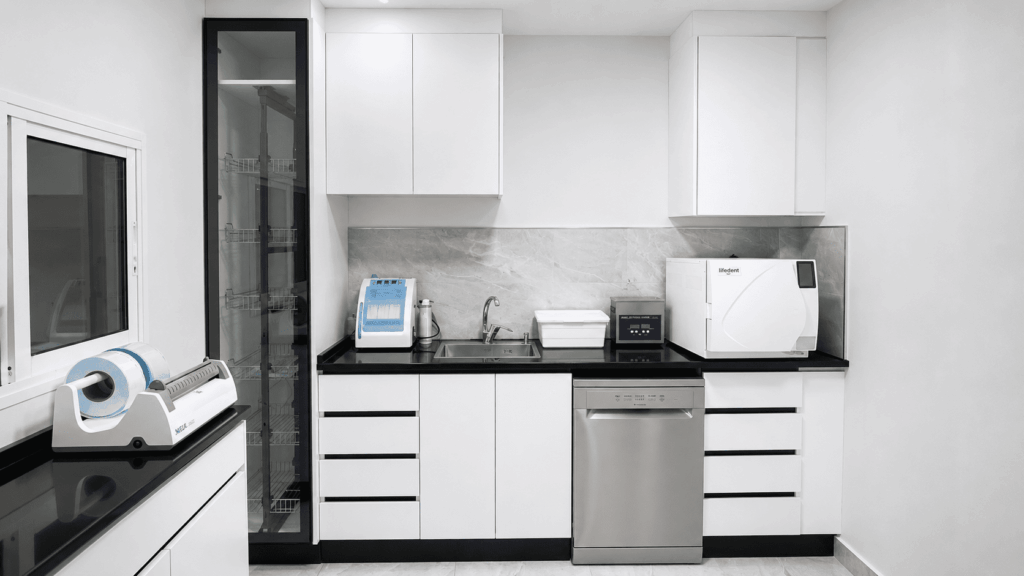
At Zoom Dental Clinic in Tabarbour, this happens in a dedicated sterilization room separate from the treatment rooms, because keeping used instruments apart from sterile ones is essential to stopping cross-contamination.
We share these details because you deserve to know them, and because asking about them at any clinic is your right, not an awkward question.
We apply the same dental sterilization and infection control standards to every patient and every visit, with extra precautions for surgical treatments such as dental implants in Tabarbour and root canal treatment. You can read what patients say about the clinic’s hygiene on its ClinicsJo page.
Sterilization protocols apply to every visit and every treatment without exception, from a routine check-up and cleaning to surgery and implants.
They matter even more for certain treatments: implants, because they open the bone; extractions and wisdom tooth surgery; root canals; deep gum treatment; and anything that involves bleeding.
They also matter more for some patients: people with weakened immunity, people with diabetes, anyone on medication that affects the immune system, and pregnant patients. They deserve to know the details before any treatment and are entitled to ask directly.
When should you ask? Any time, and especially before your first visit to a new clinic. A good clinic won’t mind the question; it’ll answer confidently and may even offer to show you the sterilization room. If a clinic hesitates or seems annoyed, that tells you something too.
Instead of symptoms, here are signs that a clinic’s standards aren’t good enough, and what to look out for as a patient:
Instruments aren’t opened in front of you from a sealed pouch, but are already laid out on the tray when you walk in.
There’s no separate sterilization room, or instruments are processed in the treatment area.
No single-use covers on the chair, headrest and handles, or covers that aren’t changed between patients.
Gloves that aren’t changed between patients, or a dentist who touches surfaces or a phone with the same gloves and then goes back to your mouth.
Hesitation or irritation when you ask about sterilization, or a vague answer like “of course everything’s sterilized”.
Single-use cups or items that look like they’ve been used before.
No sterilization indicator on the instrument pouches. That’s a strip that changes colour to confirm the cycle is complete.
This doesn’t really apply, since sterilization isn’t something done to you. But it’s worth mentioning one thing: sterilization adds no discomfort, though it can add a little time between patients.
If you wait a few extra minutes before your appointment, it’s usually because the room is being reset: covers changed, surfaces cleaned and fresh sterile instruments set up. That time isn’t poor organisation; it’s part of keeping you safe.
You may also notice instruments being opened from a sealed pouch at the start of your appointment. That’s deliberate, not for show. It’s your direct proof that nothing has been used on anyone before you.
If you have any health or immunity concerns, tell the team before you start. It helps them prepare for your visit, and it never means you’ll be treated differently.
A full sterilization cycle goes through several steps: throwing away single-use items, first cleaning to remove debris, deep cleaning, drying, sealing in dedicated pouches, sterilizing with heat under pressure, and finally storing in a dry, closed place until the moment of use.
That takes time, which is why the clinic keeps enough sets of instruments that nothing has to be used before its cycle is finished. It’s an important point: too few instruments creates pressure to cut the cycle short, and a well-equipped clinic never faces that pressure.
Between every patient, the treatment room is fully reset: covers are removed and replaced, surfaces, handles and the headrest are cleaned, and sealed sterile instruments are set out.
None of this needs anything from you. The one really helpful thing is telling the team accurately about your health and any medication you take, so your visit can be prepared properly.
A room set aside for sterilization, separate from treatment, keeps used and ready instruments apart. Separating the dirty zone from the clean zone inside that room is a core rule of infection control, and it’s what makes the process reliable rather than a set of steps done wherever there’s space.
Sterilizing an instrument isn’t enough; it has to stay sterile until it’s used. So instruments are sealed in pouches with an indicator that changes colour when the cycle is complete, and stored closed in a dry place. The pouch is only opened in front of you, and that’s proof you can see for yourself.
Some surfaces can’t be sterilized between patients, like chair handles, the headrest, the light handle and equipment covers. So they’re covered with single-use barriers that are removed and replaced after every patient. It’s a simple step that blocks one of the most common ways infection spreads in a clinic, and you can see it for yourself.
Dentist with over 19 years of international experience.
Dr. Yola Kovalenka is a distinguished medical professional in the field of dentistry.
In his practice, Dr. Mohammad Hatamleh combined academic excellence with advanced clinical training.
At Zoom Dental Clinic, every smile is treated with care, precision, and attention to detail. Our dentists provide a wide range of dental services, from preventive care and cosmetic treatments to restorative dentistry and advanced dental solutions.

Cleaning removes debris with water and detergent; it’s a necessary first step but doesn’t kill germs. Disinfection reduces germs on surfaces without killing all of them, and it’s used for surfaces and floors. Sterilization kills every form of microbe, including spores, using heat under pressure. Instruments that touch tissue or blood need full sterilization, not cleaning or disinfection.
Both. Metal instruments that can take heat go through the full sterilization cycle and are reused. Other items are made to be used once and are thrown away after every patient without exception, such as needles, gloves, cups, suction tips and protective covers. Reusing anything designed for single use is a clear breach of safety standards.
Yes, and you shouldn’t feel awkward asking. A good clinic won’t mind; it’ll be happy to show you because it’s confident in what it does. Refusing without a clear reason, getting annoyed at the question, or a vague reply like “of course everything’s sterilized” are all signs worth taking seriously when choosing a clinic.
The clearest sign is instruments being opened from a sealed pouch in front of you at the start of your appointment, rather than already laid out when you arrive. Also look on the pouch for the sterilization indicator, a strip or mark that changes colour once the cycle is complete. Together, those two things are proof you can check yourself.
The basic rules are the same for every treatment, but the precautions step up for surgery. Implants, extractions and anything that opens tissue or bone need a bigger sterile area, extra covers and instruments set aside just for that purpose. A routine check-up doesn’t need the same level, but it never skips the basics.
Yes, fully and honestly. Tell the team about any long-term condition, any medication you take and any drug allergies. It affects how your visit is prepared, the treatment decisions and what’s prescribed afterwards. And to be clear: sterilization is applied to the same standard for every patient, and your information is used to improve your care, never to treat you differently.
Why Choose Us
We use modern diagnostic
and treatment technology to support
accurate evaluation, detailed planning,
and precise dental care.
Our dental team provides attentive care,
clear treatment guidance, and
recommendationsbased on each
patient’s individual needs.
Every patient is different. We develop treatment
recommendations around your oral health,
clinical needs, comfort, and treatment goals.
From the first consultation through follow-up
care, we explain each step clearly and work
to create a calm, respectful, and
reassuring experience.
Choosing the right dental service starts with understanding your options. At Zoom Dental Clinic, we focus on clear communication, modern technology, strict sterilization, and treatment recommendations based on each patient’s individual needs.