Address
Tabarbour, Amman, Jordan
Work Hours
Saturday – Wednesday:
10:00 AM – 8:00 PM
Thursday:
10:00 AM – 6:00 PM

Orthodontic treatment moves teeth gradually into their correct position using light, continuous forces, correcting crowding, spacing and the way the jaws meet. It is a functional treatment as much as a cosmetic one.
Many people assume orthodontics in Tabarbour is purely about appearance, and the reality is broader. Crowded teeth are difficult to clean thoroughly no matter how carefully you brush, so bacteria accumulate in areas the brush cannot reach and both decay and gum inflammation increase. Bite problems, meanwhile, can produce jaw joint discomfort, recurring headaches and uneven tooth wear, because chewing force is distributed incorrectly.
At Zoom Dental Clinic, an orthodontic plan begins with a full assessment covering clinical examination, imaging and bite analysis — because the appropriate appliance and the treatment duration both depend on accurate diagnosis rather than a preselected preference.
The need for orthodontic treatment shows up in clear situations: crowded or overlapping teeth, gaps between teeth, protruding upper or lower front teeth, and an open bite where the front teeth do not meet when the jaws close.
It also applies to crossbites, mismatched midlines between the upper and lower jaws, and teeth that have tilted after a neighbouring tooth was lost and the gap left unreplaced for a long period.
For children, an early assessment is recommended to identify growth and bite issues before the permanent teeth have fully erupted, because some problems are far easier to address at that stage than later.
For adults, there is no age at which orthodontics becomes impossible, provided the gums and supporting bone are healthy. A significant proportion of orthodontic patients today are adults, and many begin treatment for purely functional reasons rather than aesthetic ones.
There is also a preparatory use: orthodontics is sometimes used before prosthetic or implant work, to open adequate space or correct a tilt that would otherwise prevent a proper restoration.
Certain indicators show that the problem has moved past appearance into function:
Difficulty cleaning specific areas between teeth, and repeated bleeding in the same spot despite consistent brushing. That is a direct sign that tooth alignment is obstructing cleaning.
Pain or clicking in the jaw joint when opening and closing, and recurring headaches around the temples, particularly in the morning.
Uneven wear along the biting edges, or small cracks appearing in specific teeth and not others — evidence that those teeth are absorbing more force than their share.
Difficulty biting or cutting food with the front teeth, and repeatedly biting the inside of the cheek or tongue.
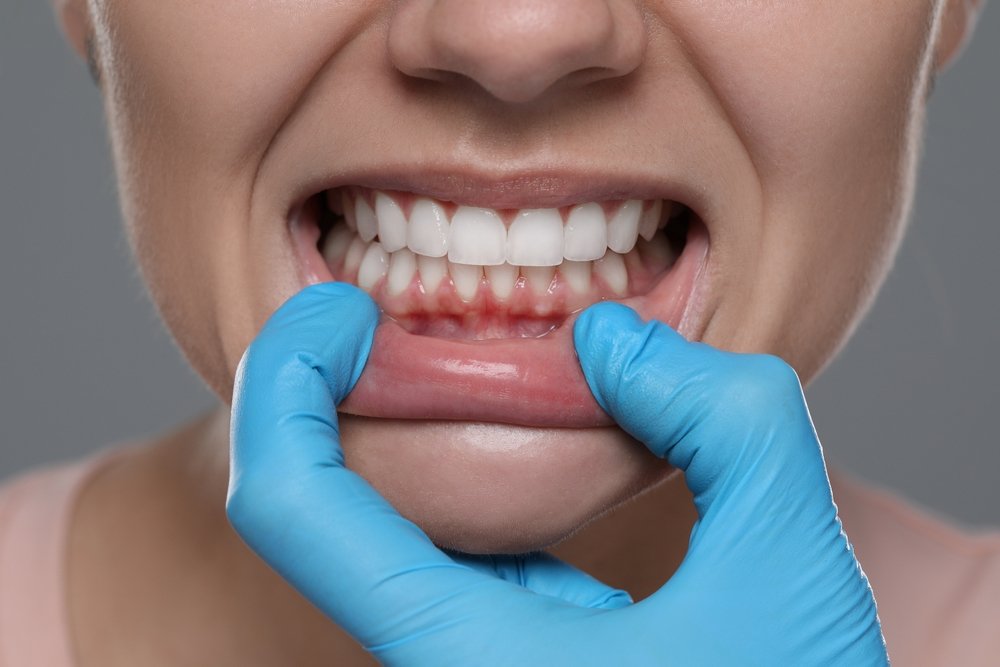
And finally: gum recession around tilted or protruding teeth, because the supporting bone in those positions is naturally thinner and more prone to receding.
Fitting braces is not painful and requires no anaesthetic. The appointment involves cleaning the tooth surfaces, bonding the brackets and placing the wire, and what you feel is unfamiliarity more than anything else.
The real discomfort begins some hours after fitting and after each adjustment, usually lasting two to four days. It feels more like tenderness when biting than sharp pain, and it happens because the teeth have actually started moving — meaning it is a sign the treatment is working.
Soft foods are easier during those days, and simple pain relief is sufficient if needed. Orthodontic wax can be used to cover any component rubbing against the cheek or lip in the first days until the mouth adapts.
Clear aligners cause less friction-related irritation, but produce a pressure sensation each time a new tray is fitted.
Contact the clinic if a wire or bracket breaks, or if sharp pain in one specific tooth continues beyond the first few days.
The fitting appointment usually takes between one and two hours depending on the appliance and the number of teeth. Adjustment visits are far shorter, generally fifteen to thirty minutes.
Reviews normally take place every four to six weeks. Keeping these appointments is not an administrative detail: a delayed adjustment means tooth movement pauses and the overall treatment lengthens, so a patient who postpones appointments is extending their own treatment.
Total duration typically runs from several months up to around two years, depending on the degree of crowding, the type of bite problem, the patient’s age and the appliance used. Simple cases limited to the front teeth finish considerably faster than cases requiring correction of the jaw relationship.
And one point that is regularly underestimated: treatment does not end when the braces come off. A retention phase follows, using a retainer, and that phase is what preserves the result. Neglecting the retainer is the leading reason teeth drift back years after treatment.
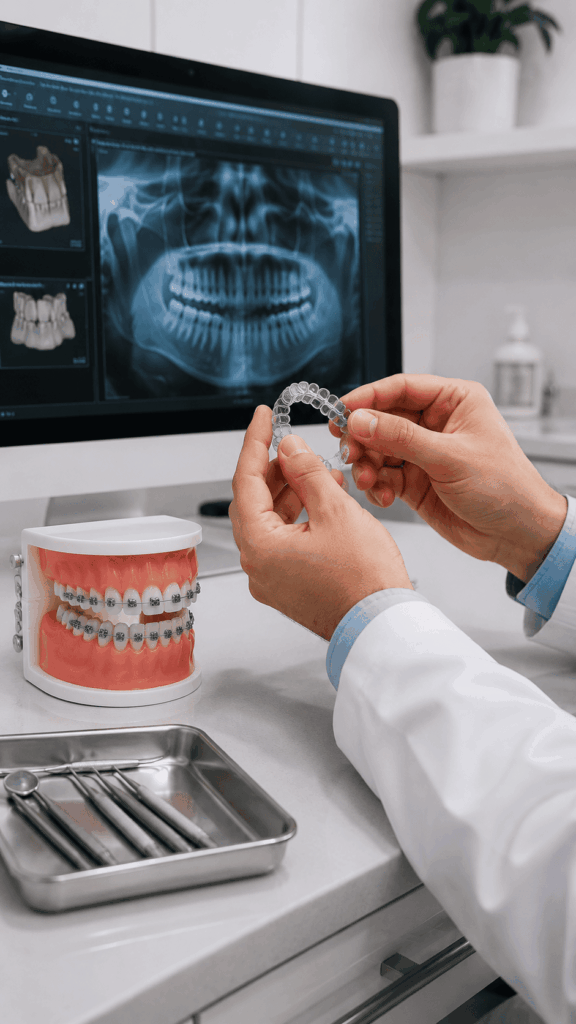
Before orthodontic treatment begins, the dentist needs to see what a direct examination cannot show: root positions and angulation, wisdom teeth and their orientation, impacted teeth, and supporting bone levels. This information determines whether the plan requires extraction, a period of waiting, or a change in sequence. Starting orthodontic treatment without this image means planning on incomplete information.
Orthodontics is not simply about moving the front teeth; it is about how the two jaws relate to each other. Bite analysis establishes how the back teeth meet, where chewing force concentrates, and whether the problem lies in the teeth themselves or in the jaw relationship. This analysis is what separates a result that lasts from one that looks good and then relapses.
No single appliance suits every case. Traditional metal braces remain the most capable option for complex cases; ceramic offers a less visible appearance with comparable efficiency; and clear aligners suit specific cases and depend entirely on the patient wearing them consistently. Presenting the options and explaining the limits of each is part of diagnosis, not marketing.
Dentist with over 19 years of international experience.
Dr. Yola Kovalenka is a distinguished medical professional in the field of dentistry.
In his practice, Dr. Mohammad Hatamleh combined academic excellence with advanced clinical training.
At Zoom Dental Clinic, every smile is treated with care, precision, and attention to detail. Our dentists provide a wide range of dental services, from preventive care and cosmetic treatments to restorative dentistry and advanced dental solutions.
Typically from several months up to around two years, depending on the degree of crowding, the type of bite problem, the patient’s age and the appliance used. Simple cases limited to the front teeth are much faster than those requiring correction of the jaw relationship. Attending adjustment appointments every four to six weeks affects duration directly — each postponed visit adds time.
Metal is the strongest option and the most capable with complex cases, and usually the least expensive. Ceramic works on the same principle but with tooth-coloured brackets, making it less visible. Clear aligners use a series of trays changed at intervals; they are less visible and easier to clean, but suit specific cases and require strict compliance with long daily wear. Your dentist recommends an option after assessing the case, not on preference alone.
Not always. Extraction becomes relevant when crowding is severe and there is not enough room in the arch for the teeth to align without protruding. In other cases space can be gained by expanding the arch or by minimal reshaping between teeth. The decision is based on space analysis and imaging, and the reasoning should be explained to you before it is carried out rather than presented as a given.
Yes, and this stage is not optional. After braces are removed, the tissues surrounding the teeth need a long period to stabilise in their new position, and without a retainer the teeth gradually drift back toward where they were. Duration and retainer type are decided by your dentist based on the case. Neglecting the retainer is the leading cause of losing a result that took months and considerable expense to achieve.
Properly managed orthodontic treatment does not damage teeth. However, the appliance makes cleaning harder, and neglecting hygiene during treatment can cause decay around the brackets, gum inflammation, and sometimes permanent white marks on the enamel. That is why healthy gums and treated decay are prerequisites before starting, and why brushing and interdental cleaning throughout treatment matter so much.
An early assessment is recommended during the mixed dentition stage, before the permanent teeth have fully erupted. The aim is not necessarily to begin treatment immediately, but to identify growth and bite problems early — some can be managed at that stage with simple appliances and growth guidance, whereas the same issues require far more extensive intervention if left until jaw growth is complete.
Why Choose Us
We use modern diagnostic
and treatment technology to support
accurate evaluation, detailed planning,
and precise dental care.
Our dental team provides attentive care,
clear treatment guidance, and
recommendationsbased on each
patient’s individual needs.
Every patient is different. We develop treatment
recommendations around your oral health,
clinical needs, comfort, and treatment goals.
From the first consultation through follow-up
care, we explain each step clearly and work
to create a calm, respectful, and
reassuring experience.
Choosing the right dental service starts with understanding your options. At Zoom Dental Clinic, we focus on clear communication, modern technology, strict sterilization, and treatment recommendations based on each patient’s individual needs.