Address
Tabarbour, Amman, Jordan
Work Hours
Saturday – Wednesday:
10:00 AM – 8:00 PM
Thursday:
10:00 AM – 6:00 PM

Address
Tabarbour, Amman, Jordan
Work Hours
Saturday – Wednesday:
10:00 AM – 8:00 PM
Thursday:
10:00 AM – 6:00 PM
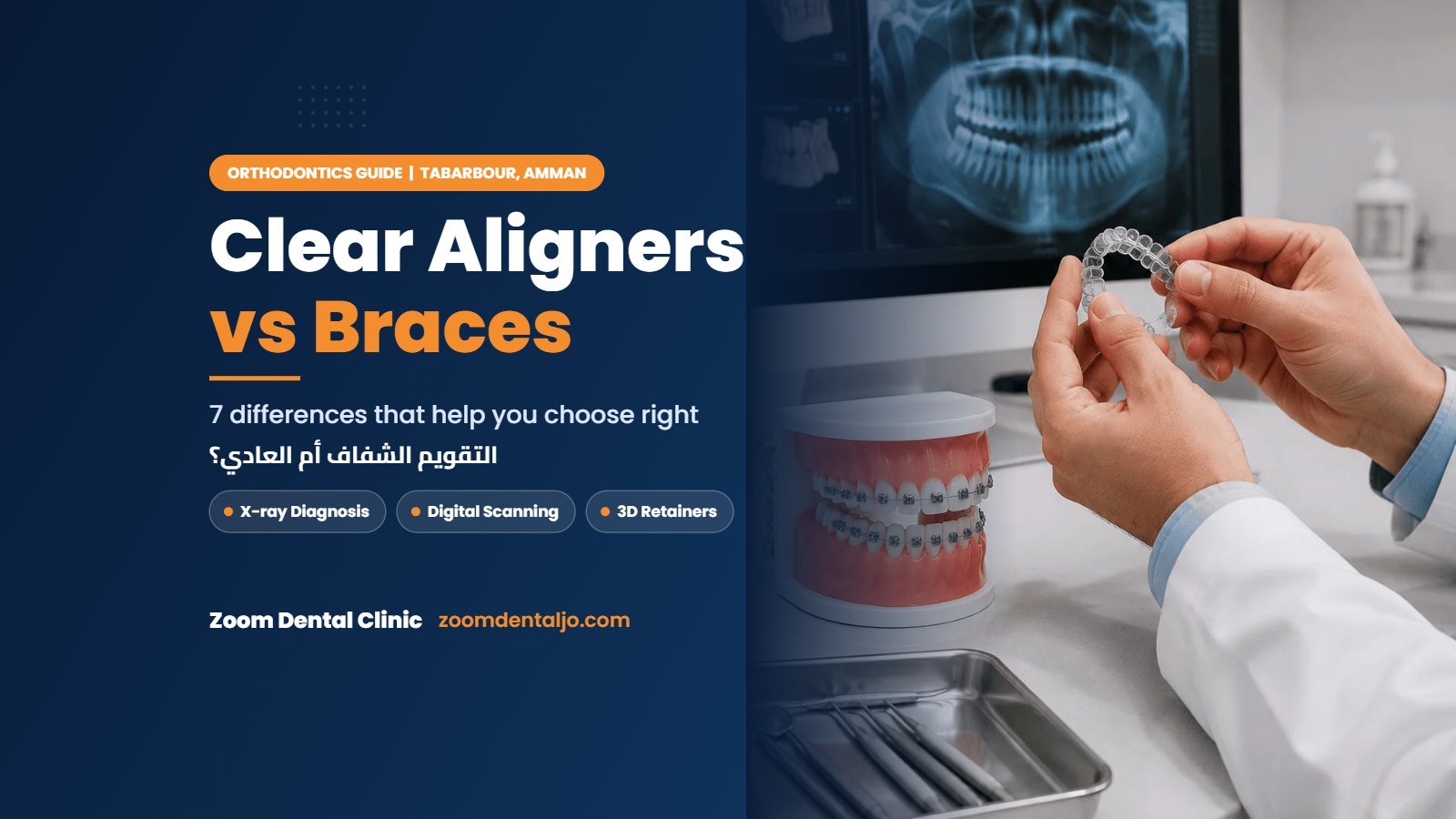
Clear aligners vs braces is usually the first question people ask once they finally decide to straighten their teeth. And by then, most have heard two opposite opinions: aligners are “just for small fixes”, or braces are “old fashioned”. Neither is true. Each option is excellent for certain cases and a weaker fit for others.
This guide explains how each one works, what changes in your daily life with each, when one clearly beats the other, and why the final choice should come from a diagnosis rather than a preference. You will also see how we plan orthodontic treatment at Zoom Dental Clinic in Tabarbour, from X-rays and digital scanning to a 3D-printed retainer at the end.
In this article
The short answer
Clear aligners suit people who want treatment that is almost invisible, can wear their trays 20 to 22 hours a day, and have mild to moderate crowding or spacing. Braces are the stronger option for complex cases, such as severely rotated teeth or significant bite problems, and for anyone who is unlikely to wear removable trays consistently. Either way, the decision should only be made after an exam and X-rays.
Both rely on the same principle: gentle, steady pressure moves teeth little by little, and the bone around each root reshapes as the tooth moves. What differs is the tool that delivers that pressure.
Small brackets are bonded to the front of the teeth and connected by a wire that the dentist adjusts at each visit. Brackets can be metal, or tooth-coloured ceramic for a more discreet look. Braces stay fixed for the whole treatment, so they keep working whether or not you remember them.
A series of thin, transparent trays, all designed in advance on a computer from a digital scan of your teeth. Each tray moves the teeth a small step, and you switch to the next one every one or two weeks as planned. In many cases, small tooth-coloured bumps called attachments are bonded to some teeth so the trays can grip and move them precisely. Many people call clear aligners “Invisalign”, which is actually one manufacturer’s brand name, not the treatment itself.
Here is the quick comparison, followed by what each point means in practice.
| Factor | Clear aligners | Braces |
|---|---|---|
| Appearance | Nearly invisible | Visible, less so with ceramic brackets |
| Comfort | Smooth; pressure for a day or two with each new tray | Possible rubbing and sore spots early on |
| Eating | Remove the trays and eat freely | Avoid hard and sticky foods |
| Hygiene | Brush and floss as usual | Takes more time and special tools |
| Commitment | 20 to 22 hours a day, and it is on you | Works around the clock without effort |
| Suitable cases | Mild to moderate, and many complex cases with proper planning | Almost every case, including the most complex |
| Visits | Fewer, mostly check-ups | Regular wire adjustments |
This is the main reason adults choose clear aligners. The trays hug the teeth closely, so most people you talk to will never notice them. Braces are visible by nature, although ceramic brackets make them much less obvious.
Aligners have no wires or metal edges, so cheek and lip irritation is rare. You will feel pressure for the first couple of days with each new tray, which simply means it is working. With braces, discomfort is more noticeable in the first weeks and after each adjustment, then the mouth adapts.
With clear aligners, you take the trays out to eat and put them back after brushing, so there is no list of forbidden foods. The one rule is that only plain water goes in with the trays. With braces, you eat with them on, so hard foods like nuts and ice, and sticky ones like gum and caramel, are best avoided because they can break a bracket or bend the wire.
Brackets and wires trap food, and cleaning around them takes time and a special brush. If it is neglected, it can leave white marks on the enamel or inflame the gums. With aligners you brush normally and clean the trays as well. With either option, we recommend regular professional teeth cleaning during treatment.
This is the difference most people underestimate. Aligners do nothing while they sit in the case. They need to be worn 20 to 22 hours a day, and if they are often forgotten or left out for long stretches, the plan falls behind and may need to be redone. Braces work day and night without you thinking about them. If you know you struggle with routines, or the patient is a teenager whose parents cannot count on daily wear, take this point seriously.
Clear aligners have improved a lot and now handle most crowding and spacing, along with many bite problems. Braces still clearly lead in some situations: severely rotated teeth, teeth that need large vertical movement, and certain severe bite issues. Which group your case belongs to cannot be judged by looking at your teeth alone; it takes X-rays and a proper analysis.
Braces need regular visits to adjust the wire and change the elastics. With aligners, the whole plan is designed in advance, so visits are fewer and mostly check that the teeth are tracking as planned. That suits people with busy schedules.
Not sure which option fits your case?
Book an orthodontic assessment at Zoom Dental Clinic in Tabarbour. We will examine your teeth and explain which option suits you and why, before you commit to anything.
Clear aligners are usually a great fit if most of these apply to you:
Braces tend to be the right call when:
It may surprise you that some people asking about orthodontics do not actually need it. If the concern is more about the shape or colour of the teeth than their position, a cosmetic option may be the answer. We explain that difference in our guide to dental veneers in Tabarbour.

Many patients arrive having already decided they want clear aligners. That is completely fair, but our job is to confirm the case allows it and that it will deliver the result they actually want. That confirmation takes three steps:
After these steps, the answer becomes clear: are aligners right for you, or will braces get you a better result faster? If both are suitable, the choice is yours, now with a full picture of the trade-offs.

Treatment ends when the teeth reach their new positions, but the job is not done. The tissues around the roots need time to settle, and during that period teeth tend to drift back. That is why a retainer matters, and skipping it is the most common reason teeth move again after orthodontics.
At Zoom Dental Clinic, retainers are designed on a computer from a digital scan taken at the end of treatment, then produced with 3D printing. The result is a retainer that matches your teeth precisely, feels comfortable, and holds the result exactly as it was achieved. This step matters whether you finished with clear aligners or braces. Read the full guide to the retainer after braces.
An exact price is not possible before an exam, because cost depends on the details of your case. The main factors are:
The best approach is a clear written plan after your assessment, covering duration, cost and what is included, rather than comparing general prices that do not reflect your case.
We offer orthodontics in Tabarbour with both braces and clear aligners, so we have no reason to push you toward one over the other. What matters to us is that you reach the right result in the way that suits your case. Here is what you can expect:
Orthodontic cases are handled by Dr. Yola Kovalenko, a dentist with more than 19 years of experience who treats both braces and clear aligner cases and plans every case with X-rays and digital scans. You can also read our guide on how to choose a dental clinic, or see patient reviews on the clinic’s ClinicsJo page.
Start with a clear answer
One assessment answers the three questions that matter most: do you need orthodontic treatment, which option suits you, and roughly how long your case will take.
Or call us directly on 0790793443
Address: Tabarbour, Amman, Jordan
Phone: 0790793443
Email: info@zoomdentaljo.com
Opening hours: Saturday to Wednesday from 10 AM to 8 PM, and Thursday from 10 AM to 6 PM.
Booking: use the contact form, book through the clinic’s page on ClinicsJo, or call us directly.
Yes, for the cases they suit, clear aligners deliver results comparable to braces. Their success depends on two things: the case being suitable from the start, and the patient wearing the trays 20 to 22 hours a day. For very complex cases, braces remain the more reliable option.
Treatment length depends more on the case than on the appliance. Simple cases can finish in six months to a year, and most cases take one to two years. For mild and moderate cases, the timeline is similar with both options, as long as aligners are worn as instructed. See our detailed guide on how long braces take.
They are not painful in the usual sense, but you will feel pressure for the first day or two of each new tray, which means the teeth are moving. The pressure fades quickly and is generally milder than the soreness after a braces adjustment.
Yes. There is no upper age limit as long as the gums and bone are healthy. Adults are actually among the most frequent aligner patients because the trays do not affect how they look at work. An assessment with X-rays confirms whether your case is suitable.
No. Take the trays out before eating or drinking anything other than water, brush your teeth, then put them back. Eating with them can crack the trays, and coloured or sweet drinks can stain them and trap sugar against the teeth.
If you wear them for fewer hours than required, the teeth do not move as planned, the next tray will not fit properly, and treatment falls behind. The dentist may need a new scan and revised trays, which adds time and cost.
Yes. A retainer is essential after any orthodontic treatment, because teeth tend to drift back. At Zoom Dental Clinic, retainers are designed digitally and 3D printed to match your teeth precisely, and the dentist explains how long to wear yours based on your case.
Zoom Dental Clinic in Tabarbour offers both clear aligners and braces, with a full assessment using X-rays and digital scanning before the treatment type is chosen, and 3D-printed retainers once treatment ends. Book through the contact form on the website or call 0790793443.
