Address
Tabarbour, Amman, Jordan
Work Hours
Saturday – Wednesday:
10:00 AM – 8:00 PM
Thursday:
10:00 AM – 6:00 PM

Address
Tabarbour, Amman, Jordan
Work Hours
Saturday – Wednesday:
10:00 AM – 8:00 PM
Thursday:
10:00 AM – 6:00 PM
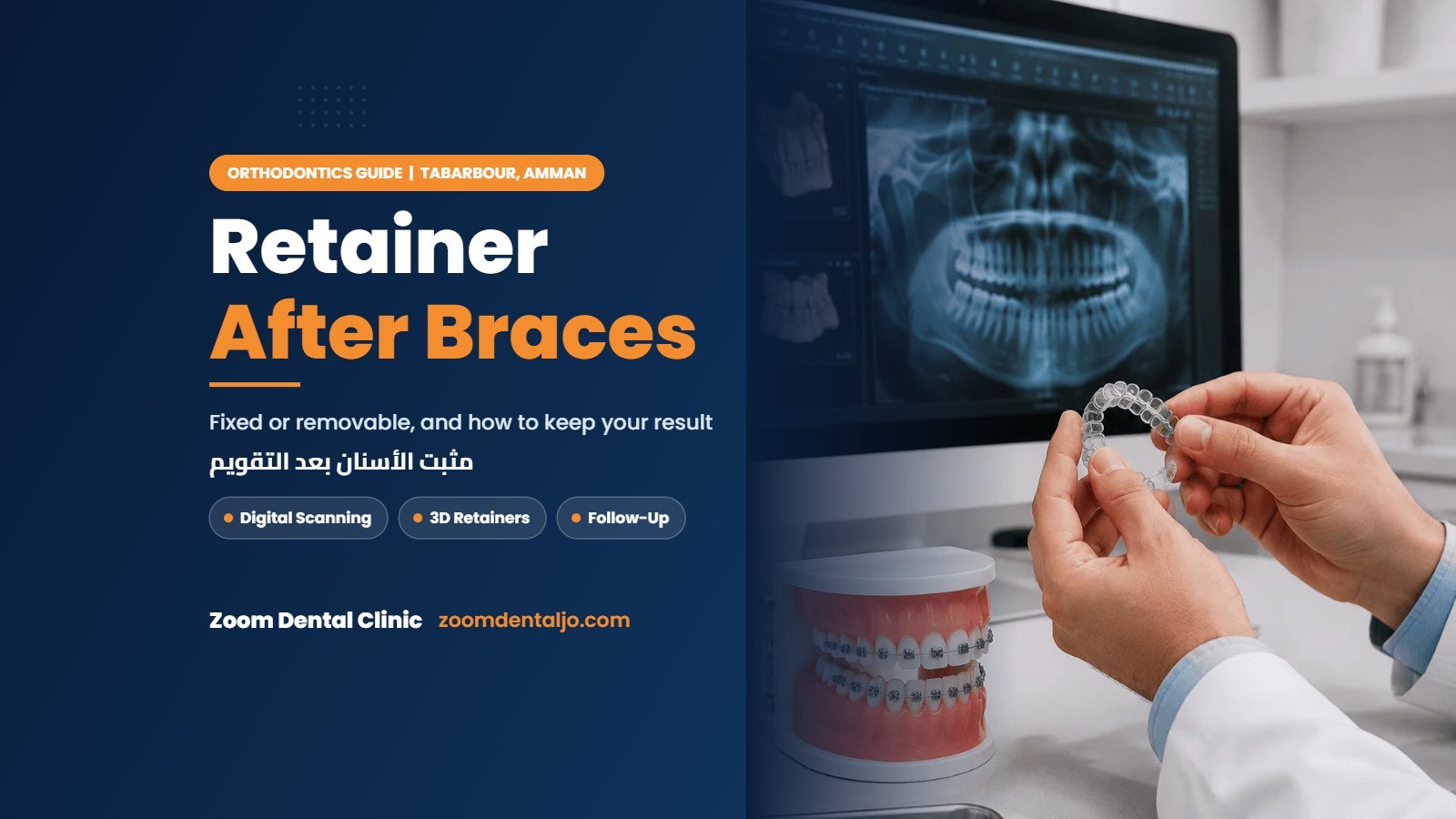
A retainer after braces is the part of treatment most people take lightly, yet it decides whether the result lasts. You spend a year or more in orthodontic treatment, the brackets come off or you finish the last aligner, and it feels like the job is done. In reality, this is exactly when your teeth are most likely to drift back.
This guide explains why teeth move after orthodontics, the difference between fixed and removable retainers, how long you need to wear one, how to look after it, and what makes a digitally designed, 3D-printed retainer different, the way we make them at Zoom Dental Clinic in Tabarbour.
In this article
The short answer
Every orthodontic patient needs a retainer after braces or aligners, because the tissues around the roots take time to settle, and without support the teeth slowly return toward their old positions. A fixed retainer is a thin wire bonded behind the front teeth; a removable one you take in and out yourself, and many patients use both. Removable retainers are usually worn most of the day for the first months, then at night for the long term, as your dentist advises.
To understand why you need a retainer after braces, start with how teeth move: they do not move alone. The bone and the fibres that attach each root to the bone move and remodel with them. When active treatment stops, some of those fibres, especially the elastic ones around the neck of the tooth, stay stretched for a long time and gently pull the tooth back toward where it started.
There is also a second reason that has nothing to do with braces: teeth naturally shift with age, even in people who never had orthodontic treatment. That is why mild crowding of the lower front teeth often appears over the years. A retainer protects your result from both.
This is why orthodontists treat the retention phase as part of the treatment itself, not an optional extra. The British Orthodontic Society also notes that teeth can move after treatment if retainers are not worn as instructed.
A thin wire bonded to the inside surface of the front teeth, usually the lower ones and sometimes the upper ones too. Nobody sees it, and you never have to remember it. The trade-off is cleaning: tartar builds up easily behind the lower teeth, and a section can come loose without you noticing, allowing a tooth to move quietly.
A thin, transparent tray, similar to a clear aligner, that holds the teeth in place. It is nearly invisible, easy to clean and comes out for meals. It only works while it is in your mouth, so success depends entirely on you wearing it.
The classic design: an acrylic plate against the palate or behind the lower teeth, with a wire across the front teeth. It is durable and adjustable, but more visible and can affect speech for the first few days.
| Factor | Fixed retainer | Clear removable retainer |
|---|---|---|
| Commitment | Works all the time, no effort needed | Works only while you wear it |
| Appearance | Hidden behind the teeth | Nearly invisible |
| Cleaning | Needs floss threaders and daily care | Normal brushing, plus cleaning the tray |
| Teeth protected | Usually the front teeth only | Every tooth the tray covers |
| Maintenance | Regular checks that it is fully bonded | Replacement when worn or cracked |
When choosing a retainer after braces, neither type wins in every case. Often the best plan is a fixed retainer on the lower front teeth plus a clear removable retainer worn at night, especially when the front teeth needed a lot of movement. Your dentist chooses based on how your teeth were before treatment and what kind of movement was done.

A traditional removable retainer starts with an impression in putty, then a plaster model, then a tray formed over it. Each step can add a tiny error, and those small errors add up to a retainer that fits less precisely than it should.
At Zoom Dental Clinic, making a retainer after braces works differently:
The result is a 3D-printed retainer that feels comfortable from day one, fits snugly without excess pressure, and holds your teeth exactly where treatment left them. And because the design is digital, a replacement is often quicker and simpler to make.
Finished or nearly finished with braces?
Book a visit at Zoom Dental Clinic in Tabarbour for a digitally designed, 3D-printed retainer that keeps your result exactly as it is.
How long to wear a retainer after braces is the most common question, and the honest answer is: longer than most people expect. A typical routine for a removable retainer looks like this:
A fixed retainer stays in place for years as long as it is intact and clean, and your dentist checks it at routine visits. Your exact plan depends on how your teeth were before treatment and the movements involved. If you are still at the planning stage, our guide on how long braces take explains the full timeline before this phase.
Do not wait. Every week without a retainer can mean movement that is hard to undo without more treatment. Contact the clinic as soon as possible, and if you have an older retainer that still fits comfortably, wear it in the meantime. If part of a fixed retainer comes loose, do not try to adjust it yourself, as the wire can push a tooth the wrong way.
If your teeth have already shifted years after treatment, the fix is often straightforward, such as a short course of clear aligners followed by a new retainer. We compare both options in clear aligners vs braces.
We plan retention as part of orthodontics in Tabarbour from day one, not as an afterthought. Here is what you can expect:
Orthodontic cases are handled by Dr. Yola Kovalenko, a dentist with more than 19 years of experience who uses X-rays and digital scans at every stage, from planning to the final retainer. You can also read patient reviews on the clinic’s ClinicsJo page.
Protect the result you worked for
Whether you finished treatment with us or elsewhere, book a visit to check your teeth and get a new 3D-printed retainer.
Or call us directly on 0790793443
Yes. A retainer is essential after any orthodontic treatment, whether braces or clear aligners. The tissues around the roots need time to settle, and without a retainer teeth tend to drift back, which can undo a year or more of treatment.
Each has strengths. A fixed retainer works all the time but needs careful cleaning, while a clear removable retainer is easy to clean but only works when you wear it. Many patients use both, and your dentist recommends the right combination for your case.
For the first months after treatment it is usually worn most of the day and night, removed only to eat and clean. After that, most patients switch to wearing it at night while sleeping, following their dentist’s instructions.
Very minor movement can happen, but it is uncommon when you wear your retainer as instructed. Noticeable movement usually comes from irregular wear of a removable retainer or a fixed retainer that came loose unnoticed, which is why routine check-ups matter.
It is designed from an accurate digital scan rather than a putty impression and plaster model, so there are fewer small errors and it fits comfortably from the first day. Having the design saved digitally also makes a replacement easier in many cases.
It depends on how it is worn and cared for. A clear retainer may need replacing once it cracks, turns cloudy or loses its snug fit. Check it regularly and bring it to your follow-up visits.
A tight retainer usually means the teeth moved slightly after a period without it. Do not force it in. Contact your dentist; wearing it for longer may be enough, or you may need a new one.
Zoom Dental Clinic in Tabarbour makes digitally designed, 3D-printed retainers after scanning your teeth, for patients who finished treatment with us or at another clinic. Book through the contact form on the website or call 0790793443.
