Address
Tabarbour, Amman, Jordan
Work Hours
Saturday – Wednesday:
10:00 AM – 8:00 PM
Thursday:
10:00 AM – 6:00 PM
Address
Tabarbour, Amman, Jordan
Work Hours
Saturday – Wednesday:
10:00 AM – 8:00 PM
Thursday:
10:00 AM – 6:00 PM
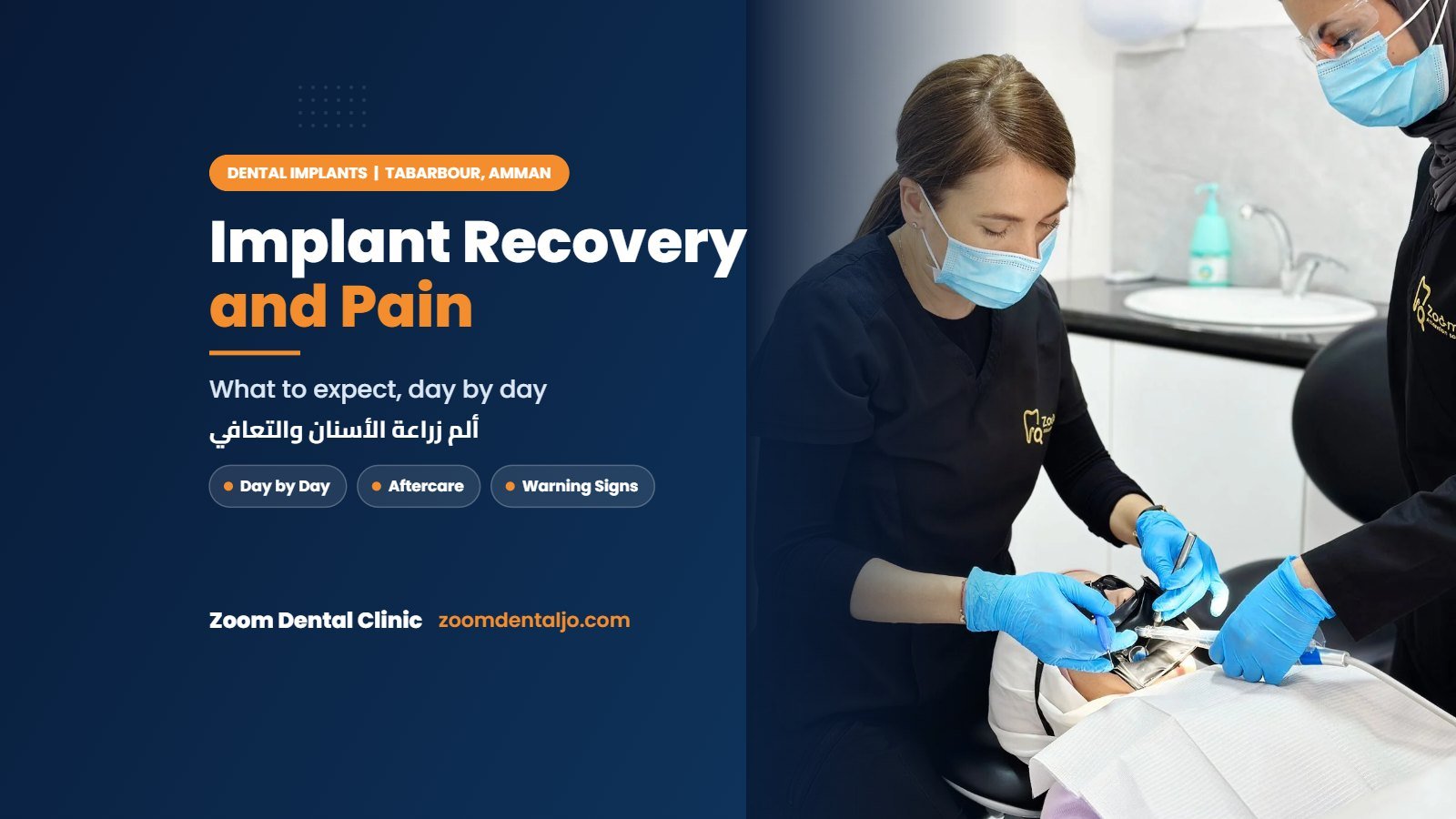
Fear of pain keeps plenty of people from a treatment they know they need. The irony is that most people who have had an implant say it was easier than they imagined, and many compare it with a tooth extraction and say the extraction was worse. This guide to dental implant recovery explains what actually happens afterwards.
You’ll find when pain peaks and when it fades, how swelling develops, what to eat, when you can go back to work, and the warning signs that mean you should call your dentist straight away.
In this article
The short answer
The procedure is done under local anaesthetic, so you shouldn’t feel pain during it. Afterwards, most patients describe mild to moderate pain that peaks on day one and roughly halves within two to three days; ordinary painkillers are usually enough. Swelling peaks around day two or three and then settles, and most people are back at work the next day.
During the procedure, no. Local anaesthetic does the job; you may feel pressure or vibration, but not pain. Once it wears off there is some discomfort, but less than most people expect. A review of patients’ pain experience after implant placement found pain was mild to moderate for most, and painkillers for the first 72 hours were usually enough.
An 84-patient study comparing implant pain with extraction pain on a 0 to 10 scale found implants clearly less painful:
| After the procedure | Extraction | Implant |
|---|---|---|
| 24 hours | 6.1 | 2.9 |
| 48 hours | 4.3 | 1.1 |
| 72 hours | 2.4 | 0.3 |
The picture changes a little when a bone graft or sinus lift is involved: swelling and bruising tend to be more noticeable and last a few days longer.
The anaesthetic wears off after a few hours and the discomfort starts. Take the painkiller your dentist recommends before the numbness fully goes, not after. Some light bleeding mixed with saliva is normal. Hold a cold pack to your cheek for ten minutes every hour during the first six hours.
Pain eases steadily, but swelling may peak now, sometimes with a light bruise on the cheek. That is part of normal healing.
Swelling goes down noticeably and most patients stop needing painkillers. Keep up the oral care your dentist described, and avoid chewing on the implant side.
Stitches come out if they aren’t the dissolving kind, and daily life is almost back to normal. What remains is the most important and quietest stage: the implant fusing with the bone.
These are the instructions medical sources agree on, including Guy’s and St Thomas’ NHS Foundation Trust. Your dentist will give you a version suited to your case:
On day one, stick to cool or lukewarm foods and liquids, such as yoghurt and lukewarm soup. Then move to soft foods like eggs, mashed potato, rice and fish, chewing on the other side. Avoid very hot, hard or crunchy foods until your dentist says otherwise, and skip alcohol.
Is fear of pain holding you back?
Book an assessment at Zoom Dental Clinic in Tabarbour. We’ll explain what will happen in your case and how we keep you comfortable before and after.
After surgery, osseointegration begins: bone grows around the implant until it becomes a fixed part of the jaw. This usually takes several months, longer if bone grafting was needed. A Cochrane review notes that loading times vary by case, and your dentist decides once the implant is stable. We cover the stages in detail in the dental implant process.
Dr. Mohammad Hatamleh focuses on implants and oral surgery. If you are still deciding, read dental implant vs bridge and dental implant cost in Jordan, or visit our dental implants in Tabarbour page.
Start by knowing what to expect
An assessment explains your implant plan and expected recovery before any procedure.
Or call us directly on 0790793443
The procedure itself doesn’t hurt because it’s done under local anaesthetic. Afterwards most patients have mild to moderate pain that eases within two to three days, usually managed with ordinary painkillers.
Pain peaks on day one and roughly halves within two to three days. Most patients stop taking painkillers within a week.
In a study comparing the two, pain after implant placement was clearly lower than after extraction over the first three days.
Most people return to work the next day; those with physically demanding jobs may need an extra day or two.
It’s best not to. Smokers’ implants fail about two and a half times as often. Ideally stop before the procedure and throughout healing.
If bleeding won’t stop, you have a temperature of 38°C or more, pain worsens after day three, numbness persists, swelling lasts beyond ten days, or the implant feels loose. You can reach Zoom Dental Clinic on 0790793443.
