Address
Tabarbour, Amman, Jordan
Work Hours
Saturday – Wednesday:
10:00 AM – 8:00 PM
Thursday:
10:00 AM – 6:00 PM

Address
Tabarbour, Amman, Jordan
Work Hours
Saturday – Wednesday:
10:00 AM – 8:00 PM
Thursday:
10:00 AM – 6:00 PM
Dental implant vs bridge is the first decision after losing a tooth, and most patients arrive having heard two opposite opinions. One says an implant is the only serious option; the other says a bridge is quicker, cheaper and does the job. The research doesn’t take sides that simply.
This article puts the comparison on the table with numbers: how long each option lasts, what happens to the neighbouring teeth, when a bridge is genuinely the smarter call, and when an implant is the better long-term investment.
In this article
The short answer
Implants and conventional bridges have similar ten-year survival, about 89% each in a large systematic review. The real difference is the price paid by the neighbouring teeth: a bridge needs two healthy teeth cut down, an implant leaves them alone. A bridge makes sense when the neighbours are already damaged; an implant is better when they are healthy and your bone and general health allow it.
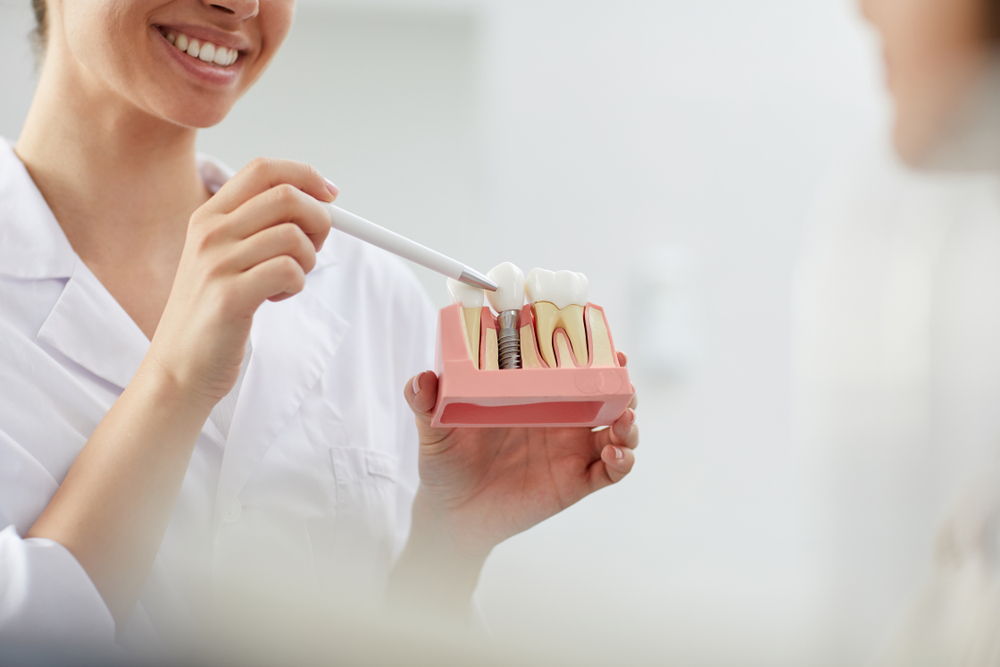
An implant is a titanium root placed in the bone where the lost root used to be, with a crown on top. The new tooth stands on its own without leaning on its neighbours.
A bridge involves preparing the teeth on either side of the gap and fitting two linked crowns that carry an artificial tooth in between. No surgery and no waiting for bone to heal, but the neighbouring teeth become supports carrying the load of three.
A systematic review in Clinical Oral Implants Research compared the two over years of follow-up, and the results were very close:
| Option | Survival at 5 years | Survival at 10 years |
|---|---|---|
| Crown on an implant | 94.5% | 89.4% |
| Conventional bridge | 93.8% | 89.2% |
A 2019 review in the Journal of Dentistry of modern implant systems found 96.4% of the implants themselves still in place after ten years.
Survival isn’t the whole story, though. The problems differ: implants see more mechanical issues such as screw loosening, and inflammation around the implant if hygiene slips. With a bridge, the trouble tends to concentrate in the supporting teeth.
This is the key difference. A bridge requires removing a large part of the outer layer of both neighbouring teeth, and that has a long-term cost. In a long follow-up study from the University of Hong Kong, around 32.5% of bridge-supporting teeth lost their nerve vitality over time, clearly more than teeth carrying a single crown.
If one support tooth decays or needs root canal treatment, the whole bridge may have to come off. An implant treats each tooth as an independent unit, so its neighbours aren’t affected by what happens to it.
A bridge is usually cheaper upfront. But a health economics study in BMC Oral Health compared the two over thirty years and found a single implant more cost-effective than a three-unit bridge, because the bridge carries the risk of extra treatment on the support teeth later. The study’s prices are European and don’t transfer directly to Jordan, but the logic does. To see what drives implant prices locally, read dental implant cost in Jordan.
Not sure which option suits your case?
Book an assessment at Zoom Dental Clinic in Tabarbour. We check the neighbouring teeth and the bone with X-rays and explain both options honestly before you decide.
We offer both options, so we have no reason to push you either way. We start with an exam and a panoramic X-ray to assess the bone and neighbouring teeth, then explain both options using your own numbers.
Dr. Mohammad Hatamleh focuses on implants, and Dr. Mutasem Irdaisat treats bridges and crowns with more than 19 years of experience. You can also visit our dental implants in Tabarbour and crowns and bridges pages.
A twenty-year decision deserves an accurate diagnosis
One visit tells you whether an implant is possible, when a bridge is smarter, and what each would cost in your case.
Or call us directly on 0790793443
Neither is better in every case. An implant is usually better when the neighbouring teeth are healthy and there is enough bone; a bridge makes sense when the neighbours need crowns anyway or surgery isn’t advisable.
In a large systematic review, ten-year survival was about 89% for both conventional bridges and implant crowns, with different types of complications for each.
A bridge requires preparing the two neighbouring teeth, some support teeth lose nerve vitality over time, and decay in one of them may mean removing the whole bridge.
Often yes, provided there is enough bone in the gap or it can be grafted. Your dentist checks this with X-rays.
A bridge is usually faster and can be completed within weeks. An implant needs several months for the bone to integrate before the final crown.
Book an assessment at Zoom Dental Clinic in Tabarbour. We check the neighbouring teeth and bone with X-rays and explain both options. Book through the contact form or call 0790793443.
